Career development rarely appears on the C-suite risk register. It should.
While most organisations acknowledge its importance, few treat it as the strategic lever it actually is. The difference between organisations at different levels of career development maturity isn’t just employee satisfaction scores. It’s measurable business outcomes: recruitment costs, revenue per employee, transformation success rates, and even company valuation multiples.
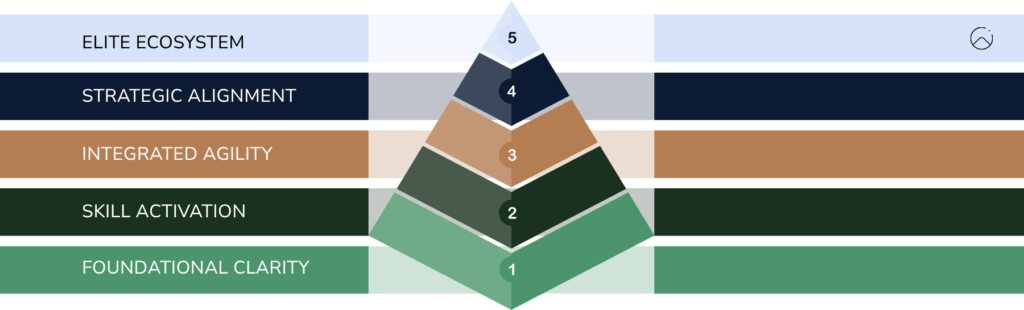
This framework maps five distinct levels of career development maturity. Each level builds on the previous one, with specific activities that drive specific business results. The goal to show you what becomes possible at each stage and help you identify your highest-leverage next move.
Level 1: Foundational Clarity (The Essentials)
The Focus: Establishing the psychological contract and operational hygiene.
Before any organisation can innovate with career development, employees must understand what’s expected of them and feel the system is fundamentally fair.
Key Activities:
- Structured onboarding that integrates talent into culture and tools
- Clear job descriptions defining the why, what, and how of every role
- Fair, competitive compensation that removes pay as a demotivator
- Transparent policies documenting how promotions and organisational changes work
- Regular manager 1-on-1s that shift managers from taskmasters to support systems
Business Outcome: Reduced Early Attrition & Increased Baseline Productivity
These aren’t nice-to-haves. Unclear expectations create expensive churn, with replacement costs ranging from 50-200% of salary. Every confused employee wastes 5-10 hours weekly seeking clarity or doing redundant work. That’s not an engagement problem. It’s a productivity tax.
Level 2: Skill Activation (Building Capability)
The Focus: Enhancing performance in current roles and preparing for the immediate future.
Once the foundation is set, mature organisations invest in the “muscles” of their workforce.
Key Activities:
- Performance reviews that evolve from annual events to continuous feedback loops
- Targeted skill development for both technical and behavioural capabilities
- Manager training focused on performance coaching, feedback delivery, and psychological safety
- Career pathing workshops helping employees visualise multi-year futures within the organisation
- Education assistance and qualification reimbursement supporting long-term growth
Business Outcome: Improved Quality of Work & Higher Engagement
Skilled employees close deals faster, deliver projects on time, and require less management intervention. This level increases revenue per employee and cuts quality-related rework costs. The investment shows up in margin improvement, not just sentiment surveys.
Level 3: Integrated Agility (The Talent Ecosystem)
The Focus: Breaking down silos and creating a fluid internal labour market.
At this level, organisations stop hoarding talent within departments and start sharing it to solve complex problems.
Key Activities:
- Internal mobility and gig platforms allowing employees to pursue projects or lateral moves across the company
- Mentorship programmes and ERGs building social capital and ensuring diverse voices access guidance
- Communities of practice formalising knowledge sharing between specialists
- Recognition programmes publicly acknowledging contributions
- Rotational programmes systematically moving high-potentials through business units
Business Outcome: Reduced Recruitment Costs & Accelerated Innovation
External hires cost 3-5x more than internal moves when you factor in fees, higher salaries, onboarding, ramp time, and failure risk. They also take 6-12 months to reach full productivity, while internal talent can pivot to new projects in weeks. This level transforms your talent base from fixed cost centres into dynamic problem-solving capacity.
Level 4: Strategic Alignment (Futureproofing)
The Focus: Identifying and preparing the next generation of leaders and specialists.
Career development becomes a risk management tool for business continuity.
Key Activities:
- Succession planning and talent reviews providing deep-dive assessments of the pipeline for critical roles
- Leadership development programmes offering cohort-based learning for emerging and mid-level leaders
- Stretch assignments and strategic projects giving high-potentials real-world business problems
- Advanced training and certifications deepening industry-specific expertise
- Global and cross-cultural assignments developing enterprise mindsets
Business Outcome: Business Continuity & Transformation Readiness
Unplanned C-suite or VP departures create 6-18 month leadership voids that stall strategic initiatives, causing missed revenue targets and market share erosion. Organisations with strong succession depth fill key roles faster, bring leaders to full impact sooner, and are significantly more likely to deliver transformations on time than peers relying on external turnaround hires.
Level 5: Elite Ecosystem (Legacy & Influence)
The Focus: Retaining top-tier talent through autonomy, purpose, and external impact.
The most mature organisations help their senior people build personal brands that reflect well on the company.
Key Activities:
- Executive coaching and sponsorship providing high-touch advocacy for the C-suite and successors
- Innovation programmes and passion projects giving experts resources to pursue moonshot ideas
- Thought leadership and personal branding support helping key talent speak at forums or publish research
- Reverse mentoring where senior leaders learn from junior staff about technology and social trends
- Legacy roles and sabbaticals allowing long-tenured experts to transition into mentoring or renewal
- Autonomy in roles, shifting from job descriptions to impact descriptions
Business Outcome: Superior Employer Brand & Sustainable Growth
Companies with recognised talent ecosystems command higher valuations (estimated 0.5-0.9x additional revenue multiple) because institutional knowledge and innovation capability become defensible assets. Client relationships deepen when your people are industry authorities, creating stickier revenue streams. Investor confidence increases when leadership bench strength is demonstrable.
What This Means for You
Most organisations cluster somewhere between Level 1 and Level 3. The framework isn’t prescriptive about where you should be. Context matters: a 200-person fintech needs different things than a 10,000-person manufacturing company.
What matters is understanding which activities you’re already doing well, which gaps create the most business friction, and what one level up would unlock.
Reflection questions:
- Which level best describes your organisation today?
- Where are you losing the most: replacement costs, skills gaps, innovation drag, leadership voids, or valuation discounts?
- What would shift if you moved up one level in the next 12 months?
The business case for career development isn’t in the future of work. It’s in this quarter’s P&L, next year’s transformation roadmap, and your organisation’s ability to execute strategy without existential talent risk.
If you’d like to talk through how to leverage what you already have in place, or identify your organisation’s highest-leverage next move, I’d welcome the conversation.