
We’ve all seen the org chart. Clean boxes, clear reporting lines, an obvious path from bottom to top. It looks like a ladder, and we’ve been conditioned to believe that’s how careers work.
Except it isn’t. And it never really was.
The Brief History of a Persistent Myth
The career ladder feels like common sense, but for most of the 20th century, careers didn’t follow neat upward trajectories:
100 years ago, most people had 1-2 jobs across their entire working lives. Career “planning” wasn’t a concept. You worked where your family worked, where apprenticeships existed, or where local industry needed bodies. Climbing wasn’t part of the vocabulary because organizational structures were relatively flat.
50 years ago, the ladder myth was born. Corporate hierarchies expanded dramatically, management layers multiplied, and the idea of climbing from entry-level to executive became not just possible but expected. Companies created formal progression frameworks, and crucially, people stayed long enough (5-10 years in a single role) to climb them.
Today, we’re averaging 10-15 jobs per career with 3-5 years in each role. Yet we’re still measuring success against a benchmark that existed for barely one generation.
What the Data Actually Shows
While we’ve been clinging to ladder language, the reality of how careers develop has been transforming:
- Internal mobility activity in 2023 was nearly 25% higher than in 2019 and most of these moves are lateral, diagonal, or scope-expansion roles rather than traditional promotions.
- Employees at companies with strong internal mobility stay about twice as long (5.4 years vs 2.9 years), which is why progressive organisations are investing in structured lateral movement and redeployment programs instead of relying solely on vertical promotion.
- Skills-first hiring and internal mobility practices now treat varied, cross-functional experience as a positive signal of adaptability and leadership potential; structurally rewarding non-linear trajectories rather than penalising them.
The ladder isn’t just outdated. It’s actively misleading us about what career development looks like in practice.
Why We Can’t Let Go
The ladder metaphor persists because it offers something seductive: clarity. Org charts make progression look visible and predictable. We can point to the next box up and call it growth.
But that false clarity comes at a cost:
- We feel like failures when our careers zigzag instead of moving steadily upward
- We chase promotions that aren’t right for us because we’ve been told “up” is the only legitimate direction
- We overlook powerful development opportunities because they don’t come with a new title
- We design talent systems around vertical movement, then wonder why retention, engagement, and skill development aren’t keeping pace
What’s Actually Happening: 15 Career Moves That Aren’t Ladders
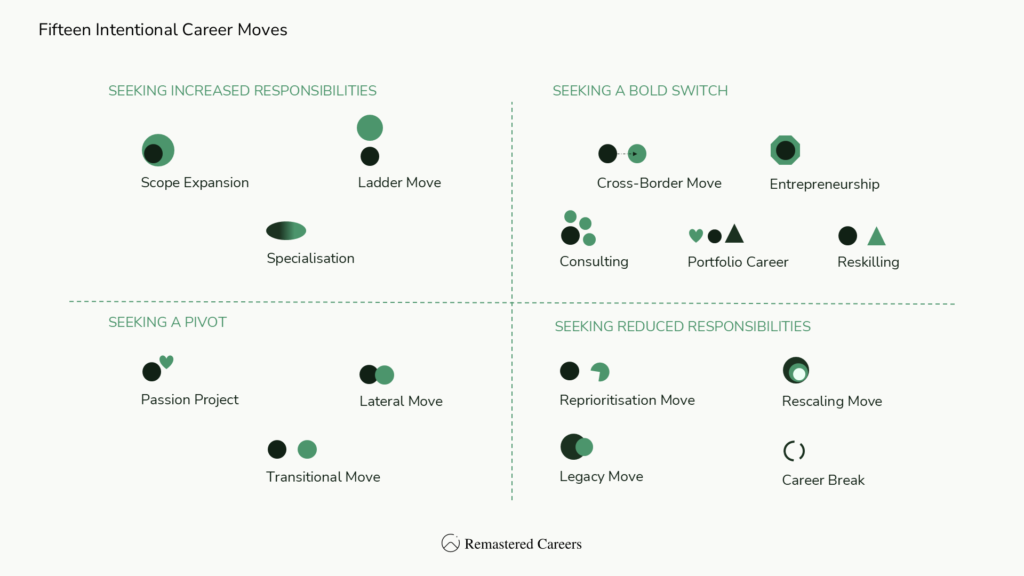
Career paths aren’t dead – they’re just not ladders. They’re networks of intentional moves, each serving different purposes:
Some moves expand impact: scope expansion (broader responsibility without changing titles), specialisation (deepening expertise), traditional ladder moves (where they genuinely exist).
Others create breathing room: re-scaling (right-sizing workload), career breaks (deliberate pauses), legacy moves (shifting from doing to guiding), reprioritisation (aligning work with current life priorities).
Some open new territory: lateral moves (shifting function), transitional moves (changing industry), passion projects (meaningful work alongside career).
And some enable transformation: reskilling (building entirely new capabilities), entrepreneurship, consulting, portfolio careers, cross-border moves.
These aren’t consolation prizes for people who “failed” to climb. They’re legitimate, strategic career moves – and the data shows they’re increasingly how growth happens.
The Real Opportunity
For individuals, this means expanding your definition of career success beyond vertical movement. Growth isn’t just upward; it’s outward, deeper, broader, sometimes intentionally smaller.
For organisations, this means designing career development systems that recognise and enable these diverse moves. Instead of waiting for promotion opportunities to appear randomly, you can create structured pathways for lateral development, scope expansion, and skill-building that serve both business needs and individual growth.
The ladder was always an illusion. A brief historical moment we mistook for a universal truth. What we’re seeing now isn’t career chaos. It’s career evolution.
The question isn’t “How do I climb?”
It’s “Which move serves my growth right now?”
Want to explore which career move makes sense for you, or how to build career development systems that reflect how growth happens? Let’s talk. Contact Remastered Careers